September 26, 2026 — Huawei has unveiled two new research reports. outlining a roadmap for the next phase of digital and intelligent transformation, including ten key directions for building the Intelligent World 2035.




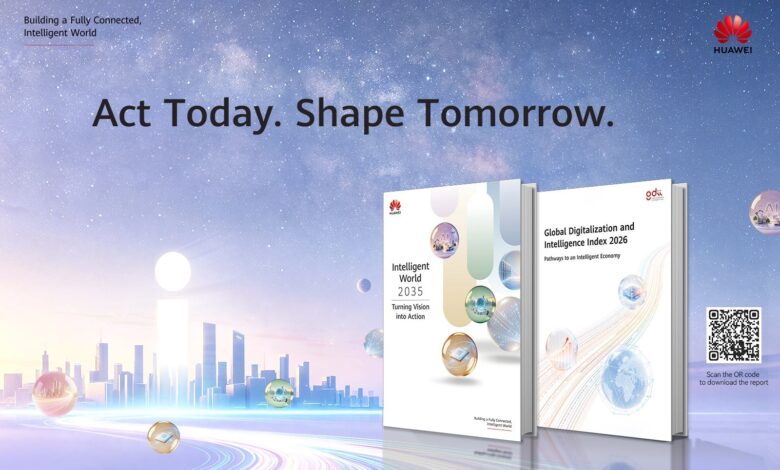
The reports, “Intelligent World 2035: Turning Vision into Action” and “Global Digitalization and Intelligence Index 2026,” were released during an online launch event themed “Act Today. Shape Tomorrow.”
The new Intelligent World 2035 report builds on the technology trends identified in Huawei’s previous reports. It focuses on the rapid development of agentic artificial intelligence (AI) and examines the infrastructure, technologies, and industry changes required to support an increasingly intelligent world.
Agentic AI Drives a New Digital Era
According to Huawei, AI is expanding beyond the digital world and increasingly entering physical environments. At the same time, it is moving from being a standalone tool to becoming part of core business processes and social activities.
David Wang, Deputy Chairman of the Board and Rotating Chairman of Huawei, said that agentic AI represents a key factor in this transformation. He emphasized that turning the vision of an intelligent world into reality requires concrete action to address emerging challenges in infrastructure, operations, and industrial development.
The report describes a shift from an application-centric digital world toward an agent-centric world, where AI agents can continuously perceive their environments, reason autonomously, make decisions, use digital tools, and interact with people in real time.
Huawei predicts that global annual token consumption could increase 100,000-fold by 2035, with AI-agent traffic accounting for more than 90% of overall traffic. This expected growth will create significant demands on computing, networking, storage, and cloud infrastructure.
Huawei Identifies 10 Key Directions
To address these challenges, Huawei’s report identifies ten key directions for the Intelligent World 2035:
1. Building AGI with autonomous cognition and general capabilities for a wide range of tasks by advancing language, embodied, and scientific intelligence.
2. Scaling computing clusters 100-fold and reducing agent task costs 1,000-fold through advances in chip-level computing and SuperPoD systems.
3. Developing new storage and memory systems that provide greater causal accuracy and trustworthy traceability, supporting the evolution from data to knowledge and memory.
4. Building experience-centric intelligent connectivity infrastructure with AI increasingly integrated into communications systems.
5. Exploring the Tau Scaling Law to optimize chip latency and energy efficiency and support the next stage of semiconductor development.
6. Developing an Agent OS that provides an agent-native technical foundation based on coordination, execution, memory, connectivity, and continuous evolution.
7. Creating adaptive and ubiquitous device intelligence to deliver intelligent services across devices, environments, and use cases.
8. Advancing self-learning and safety in intelligent driving to enable vehicles to evolve into mobile embodied agents.
9. Breaking power and thermal limitations to support the continued expansion of AI computing in data centers.
10. Strengthening security and privacy protection to safeguard an intelligent world powered by autonomous AI agents.
Building Token-Centric Intelligent Infrastructure
Huawei says these developments require a new generation of token-centric, end-to-end intelligent infrastructure covering token generation, delivery, consumption, and security.
The company highlights the development of SuperPoD systems and open ecosystems to improve token production efficiency. It also emphasizes intelligent connectivity infrastructure to support seamless token flows, alongside agentic-native cloud platforms that can accelerate AI adoption across industries.
According to the report, these technologies could transform tokens into perceivable intelligent services and reshape both personal digital experiences and enterprise operating models.
Huawei Calls for Five Key Initiatives
The report concludes with five initiatives aimed at turning technological innovation into practical progress.
These include taking a long-term approach, remaining people-centric, promoting technology for good, maintaining openness and collaboration, and adopting a systems approach.
Wang said in the report’s foreword that Huawei is ready to work with customers and partners worldwide to translate practical steps taken today into progress toward the Intelligent World 2035.
Global Digitalization and Intelligence Index 2026
Huawei also released the Global Digitalization and Intelligence Index 2026, jointly developed with the Institute of Economics at Tsinghua University.
The report forecasts that AI could generate more than US$27 trillion in cumulative economic value over the next five years. It also projects that global investment in digital and intelligent infrastructure could grow at a compound annual growth rate of 19.14%, exceeding US$4 trillion by 2030.
The index examines the digital and intelligent development of 90 countries and classifies them into three stages: Builder, Adopter, and Frontrunner.
The report identifies data, ICT talent, and digital and intelligent technologies as core factors of production in the digital and intelligent economy. It also highlights the importance of integrating networking, computing, and storage to support industrial upgrading.
Huawei and Tsinghua University emphasize that there is no single development model for the intelligent era. Instead, quantitative assessment can help each country identify its priorities and develop a pathway suited to its own economic and technological conditions.
With its two new reports, Huawei presents a roadmap focused on infrastructure, AI agents, connectivity, computing, security, and digital investment as key foundations for the development of the Intelligent World toward 2035.