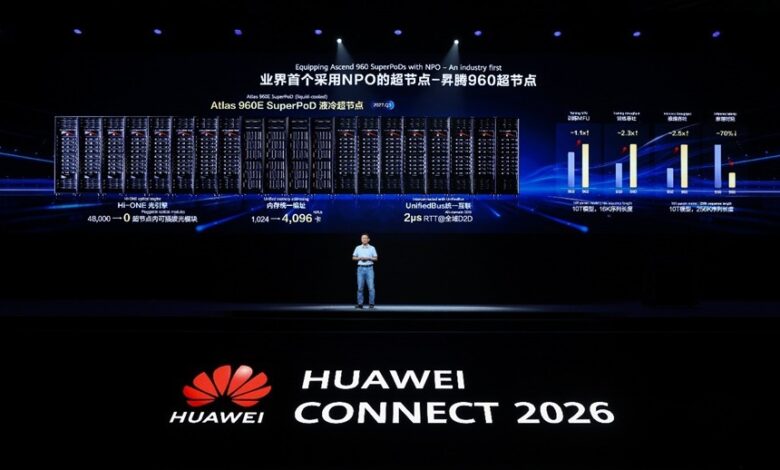
Shanghai, China – September 23, 2026: Huawei has unveiled the Atlas 960E SuperPoD, the world’s first SuperPoD based on near-packaged optics (NPO), at HUAWEI CONNECT 2026 in Shanghai.


The new system was launched by David Wang, Deputy Chairman of the Board and Rotating Chairman at Huawei, during his keynote speech, “Advancing the Agentic World, Building a Solid Silicon Foundation.” The Atlas 960E SuperPoD is designed to accelerate the training and inference of foundation models with up to 10 trillion parameters.
Building the Infrastructure for the Intelligent Era
Huawei is focusing its AI strategy on computing power and hardware innovation as it works to strengthen the infrastructure supporting the intelligent world.
The company is building its AI infrastructure around SuperPoDs and SuperClusters, while promoting open-source technologies and open systems to expand computing ecosystems.
As foundation models continue to grow in scale, Huawei says SuperPoDs can provide a high-performance architecture for AI infrastructure. Its design connects cluster components through a unified protocol and peer-to-peer interconnect, enabling cross-server memory access.
Huawei has also integrated optical technologies into its SuperPoD architecture. The company introduced Hi-ONE, which it describes as the industry’s first mass-produced NPO optical engine with a built-in light source.
Hi-ONE provides a transmission capacity of up to 7.2 Tbit/s, according to Huawei.
Atlas 960E SuperPoD Delivers up to 16 EFLOPS
The Atlas 960E SuperPoD combines UnifiedBus and Hi-ONE technologies with an orthogonal architecture and fully liquid-cooled design.
Through UnifiedBus, the system supports unified memory addressing and can scale to 4,096 NPUs within a single SuperPoD.
Huawei says the system can deliver up to 8 EFLOPS at FP8 precision and 16 EFLOPS at FP4 precision.
The Atlas 960E SuperPoD integrates approximately 5,500 Hi-ONE units, reducing the need for the 48,000 800G optical modules traditionally required to connect the NPUs.
According to Huawei, this architecture can reduce power consumption by more than 550 kilowatts. It can also double the system’s fault-free operating time and achieve 99.8% system availability.
Huawei expects these capabilities to support faster training and inference for advanced foundation models.
Huawei Expands SuperPoD Architecture
Huawei has also extended its SuperPoD architecture to general-purpose computing systems with the upgraded TaiShan 950 SuperPoD.
Powered by UnifiedBus all-optical networking, the system supports up to 4,096 nodes and a unified memory pool of up to 256 TB.
The company says the architecture enables higher-density agent sandboxes, faster sandbox startup, and improved performance for agent vector searches.
Huawei also introduced OceanStor M900, a UnifiedBus-powered context memory storage cluster. The system supports direct one-hop access and provides a petabyte-scale KV cache for the L3.5 layer.
SuperCluster Can Scale to One Million NPUs
Multiple Atlas 960E SuperPoDs can be connected through UnifiedBus or RoCE to create larger SuperClusters.
Using a two-tier, four-plane Clos architecture, Huawei says a SuperCluster can interconnect up to 512,000 NPUs. With a multi-rail topology, the architecture can scale to one million NPUs.
Huawei Advances Open-Source AI Ecosystem
David Wang also highlighted Huawei’s strategy of developing open-source technologies and open systems to support the broader computing ecosystem.
Huawei’s CANN platform is now available as open source and has moved toward sustained, community-driven development.
According to Wang, this development is intended to make the Ascend ecosystem more accessible and user-friendly while supporting native training for mainstream foundation models.
“At Huawei, we are committed to building powerful AI infrastructure and going open source and open system to build out computing ecosystems,” Wang said.
“We will continue to support native training for mainstream foundation models on Ascend and actively embrace a wide range of models and applications. Together, let’s lead the charge into the intelligent world.”
HUAWEI CONNECT 2026
Held under the theme “Advancing the Agentic World,” HUAWEI CONNECT 2026 focuses on AI across three areas: strategy, technology, and ecosystems.
The event showcases Huawei’s latest digital and intelligent infrastructure products, industry-specific solutions, and development tools.
HUAWEI CONNECT 2026 is being held from September 17 to 19 at the Shanghai World Expo Exhibition & Convention Center and Shanghai Expo Center in Shanghai.